You Won’t Believe What Malé’s Street Food Scene Actually Tastes Like
When you think of the Maldives, images of overwater bungalows and white-sand islands come to mind—but Malé? Most travelers skip it, assuming it’s just a transit hub. I did too, until I wandered its narrow alleys and stumbled upon a side of the city nobody talks about: its vibrant, chaotic, flavor-packed street food culture. In this tiny urban maze, every corner serves something bold—spicy, smoky, unforgettable. This is not resort cuisine. This is real Maldivian life, served hot on paper plates. What I discovered was not just food, but a rhythm of daily existence rooted in centuries of maritime tradition, community resilience, and culinary simplicity. Malé may be small in size, but its palate is vast, alive, and deeply inviting to those willing to look beyond the airport shuttle.
Reimagining Malé: Beyond the Transit Stop
Malé, the capital of the Maldives, is often reduced to a footnote in travel itineraries—a brief stop between international flights and resort transfers. Yet beneath this utilitarian perception lies a city pulsing with energy, history, and humanity. Covering just over eight square kilometers and home to more than 200,000 people, Malé is one of the most densely populated cities on Earth. Its streets are narrow, its buildings rise vertically out of necessity, and its sidewalks buzz with motorbikes, schoolchildren, and vendors balancing trays of food on their heads. It is a city shaped by space constraints, geographic isolation, and a strong sense of national identity.
Unlike the serene, carefully curated environments of private island resorts, Malé offers an unfiltered experience of Maldivian life. There are no infinity pools here, no curated sunset dinners with champagne flutes. Instead, there are open-air markets stacked with fresh fish, mosques with coral-stone foundations, and families sharing meals on plastic stools outside their homes. This contrast is not a deficiency—it is a revelation. For travelers seeking authenticity, Malé presents a rare opportunity to engage with the cultural heart of the nation, where traditions are lived rather than performed for guests.
And nowhere is this authenticity more evident than in the city’s food culture. While resorts serve international fare with a tropical twist, Malé’s kitchens turn out dishes rooted in centuries of island living—simple, nourishing, and deeply flavorful. The ingredients are local: reef fish, coconut, starches like taro and breadfruit, and spices carried across the Indian Ocean for generations. Eating here is not about luxury presentation; it’s about sustenance, connection, and flavor passed down through families. To understand the Maldives fully, one must step off the tourist path and into the alleys of Malé, where the true taste of the archipelago begins.
The Pulse of Urban Flavor: Where Food Meets Daily Life
In Malé, food is not an event—it is a constant. It shapes the rhythm of the day, from dawn fish auctions to late-night tea stalls where fishermen unwind after long hours at sea. The city’s compactness means that nearly every resident lives within walking distance of multiple food sources, whether a small family-run café, a roadside snack cart, or a bustling market stall. This proximity fosters a culture of immediacy and freshness, where meals are prepared in real time and eaten close to where they are made.
Mornings begin at the Malé Fish Market, a sensory explosion of salt air, ice-packed stalls, and glistening catches hauled in overnight. Here, yellowfin tuna, wahoo, and jobfish are auctioned within hours of landing. Vendors shout prices, scales flash in the sun, and housewives inspect fillets with practiced eyes. Nearby, small eateries fire up their stoves, simmering pots of garudhiya—clear fish broth that forms the backbone of Maldivian cuisine. The aroma of boiling tuna and curry leaves drifts through the streets, mingling with the scent of frying onions and toasted coconut.
By mid-morning, the city shifts into breakfast mode. Office workers pause at roadside stands for mas huni, a staple dish of finely shredded smoked tuna mixed with grated coconut, onions, and chili, served with flatbread called roshi. The preparation is quick but precise: the tuna is flaked by hand, the coconut freshly grated, and the chilies adjusted to taste. It’s a dish born of necessity—protein-rich, shelf-stable, and easy to assemble—but elevated by generations of careful technique. These simple meals are not just sustenance; they are acts of continuity, linking modern Malé to centuries of seafaring tradition.
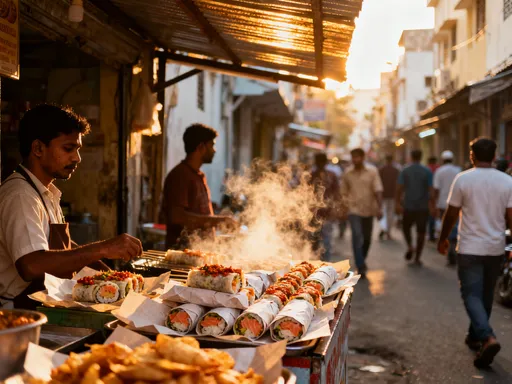
Lunchtime brings another wave of activity. Hawkers set up temporary stalls under umbrellas, offering hedhikaa—Maldivian snacks that range from savory to subtly sweet. Bajiya, the local version of samosas, are filled with spiced tuna or vegetables and deep-fried until golden. Gulha, small dough balls stuffed with tuna paste and fenugreek, are chewy and aromatic. These bites are eaten standing up, often shared among colleagues during short breaks. There is no formality, no expectation of a sit-down meal—just quick, satisfying nourishment that keeps the city moving. This seamless integration of food into daily routines reveals a culture where eating is not separate from life, but woven into its very fabric.
Must-Try Street Eats: From Garudhiya to Mas Huni
To eat in Malé is to taste the essence of the Maldives. The cuisine is built on a few core ingredients—fish, coconut, starch, and spice—but transformed through careful preparation into dishes of remarkable depth. Among the most essential is garudhiya, a clear fish broth traditionally served with rice, lime, chili, and onions. It may sound simple, but the clarity of the broth reflects a meticulous process: fresh tuna is simmered slowly, impurities skimmed off, and no heavy spices added. The result is a clean, umami-rich liquid that warms the body and soothes the soul. Locals often drink it plain in the morning, believing it aids digestion and boosts energy.
Equally iconic is mas huni, a breakfast staple found in nearly every home and café. Made from smoked or cooked tuna, it is shredded by hand and mixed with freshly grated coconut, finely chopped onions, green chilies, and a squeeze of lime. The texture is coarse yet balanced, the flavors bold but not overwhelming. Served with warm roshi—a soft, flaky flatbread—mas huni is both filling and refreshing, perfect for starting the day in a hot, humid climate. Families often prepare it together, turning breakfast into a quiet moment of connection before the city wakes fully.
For those exploring on foot, hedhikaa offers a delicious way to sample multiple flavors in one outing. These small snacks are sold at dedicated stalls, often labeled simply as “Hedhikaa” with a handwritten menu. Bajiya, perhaps the most recognizable, are triangular pastries filled with a mixture of tuna, onion, curry leaves, and mustard seeds. They are fried until crisp, their golden crust giving way to a smoky, savory interior. Gulha, another favorite, are round dumplings made from wheat flour and stuffed with a spiced tuna paste. What sets them apart is the use of fenugreek, which adds a slightly bitter, aromatic note that balances the richness of the fish.
Less common but equally rewarding is kulhi boakiba, a fish cake made from mashed tuna, grated coconut, and egg, then pan-fried until firm. It has a dense, almost meatloaf-like texture and is often served with a side of chili sauce. Another treat is bondibai, a sweet pastry filled with coconut, jaggery, and cardamom—ideal for those with a preference for milder flavors. These dishes, while humble in appearance, represent the ingenuity of Maldivian cooking: making the most of limited ingredients through skill, patience, and tradition.
Hidden Eateries: Finding Flavor in Unexpected Corners
While Malé has a few well-known eateries, some of the best food is found in places that don’t advertise. There are no neon signs, no Instagrammable interiors—just small windows cut into concrete walls, where a cook in a white apron hands out steaming packets of food to a steady stream of customers. These unmarked spots are often family-run, operating for decades on reputation alone. Locals know them by word of mouth, and their loyalty ensures freshness and consistency.
One such spot, tucked behind the Islamic Centre, serves some of the crispiest bajiya in the city. The owner, a woman in her sixties, prepares the filling early each morning, frying the onions until golden and adding a precise pinch of turmeric for color. The dough is rolled thin, filled, and sealed by hand—no machines, no shortcuts. Customers arrive throughout the day, some ordering by number (“Two bajiya, one gulha”), others by habit (“The usual”). Prices remain low—typically less than a dollar per item—making these snacks accessible to everyone from office clerks to construction workers.
Another hidden gem is a tiny takeaway near the harbor that specializes in garudhiya and short eats. Open only from 6 a.m. to 10 a.m., it caters to fishermen returning from night trips. The broth is served in plastic bowls with a side of rice and a lime wedge. Regulars often add their own mix of chili and onion, customizing each bowl to taste. The owner doesn’t speak much English, but a smile and a nod are enough to place an order. This kind of quiet efficiency is common in Malé’s food scene—there’s no need for menus or branding when the food speaks for itself.
For visitors, finding these spots requires curiosity and a willingness to wander. Look for clusters of locals, especially in the early morning or late afternoon. Follow the scent of frying dough or simmering fish. Don’t be deterred by plain exteriors; some of the best food comes from the most unassuming places. And while hygiene standards may differ from Western expectations, the high turnover of ingredients and constant cooking ensure that food is fresh and safe. When in doubt, observe what others are eating and follow their lead. In Malé, the crowd is the best guide.
The Role of Community in Malé’s Food Culture
Food in Malé is not just about nutrition—it is a social act. In a city where space is limited and homes are often small, public eating areas become extensions of the living room. Shared tables outside cafés, benches near markets, and even sidewalks become informal dining rooms where neighbors gather, exchange news, and enjoy meals together. This communal approach is not by choice alone, but by necessity—and it has fostered a culture of openness and connection.
At dusk, when the heat begins to ease, the city comes alive with food-centered gatherings. Families sit on low stools outside their homes, sharing plates of rice and fish. Office workers meet at tea stalls, sipping sweet milky tea and nibbling on bajiya. Fishermen unwind after long days at sea, laughing over bowls of garudhiya. These moments are not staged for tourists; they are part of the daily rhythm. There is a quiet dignity in these interactions—a sense that eating together strengthens bonds, even among strangers.
Even in fast-paced environments like the fish market, food fosters cooperation. Vendors share stoves, borrow utensils, and taste each other’s dishes. A cook might hand a sample of her latest batch to a passing neighbor, seeking approval. These small gestures build trust and solidarity in a high-density urban setting where privacy is scarce but community is strong. Food becomes a language of care, a way of saying, “I see you, I know you, we belong to the same place.”
This sense of shared experience extends to visitors who engage respectfully with the food culture. A traveler who sits on a plastic chair, eats with their hands, and smiles at the cook is not just consuming a meal—they are participating in a tradition. They may not speak the language, but they understand the unspoken rules: eat slowly, appreciate the effort, and show gratitude. In these moments, the boundary between local and visitor blurs, and the city reveals its warmth.
Navigating the City Like a Local: Practical Tips for Food Exploration
Exploring Malé’s street food scene is rewarding, but a few practical tips can enhance the experience. The best time to visit is early morning, between 6 a.m. and 9 a.m., when markets are busiest and food is freshly prepared. The Malé Fish Market is particularly vibrant during this window, offering a front-row view of the day’s catch and the first rounds of cooking. Lunchtime, from 12 p.m. to 2 p.m., is another peak period, especially around government offices and schools.
Getting around is straightforward. The city is walkable, and most food spots are within a 20-minute stroll of the harbor or airport ferry terminal. For longer distances, local taxis—usually white sedans with green license plates—are affordable and plentiful. Simply wave one down or ask a shopkeeper to call one. Ferries from nearby islands like Hulhulé or Villimalé also bring in commuters, many of whom stop for a quick bite upon arrival, making waterfront areas especially lively.
When ordering, a few basic Dhivehi phrases go a long way. “Ekai?” means “How much?” and is useful for checking prices. “Ekama?” means “Is it ready?” and helps avoid waiting too long. “Shukuriyya” (thank you) is always appreciated. While many vendors understand simple English, using local words shows respect and often earns a warmer response. Pointing at what others are eating is also perfectly acceptable—sometimes the best menu is the one already in someone’s hands.
Hygiene is generally good, with most vendors using gloves or tongs and cooking food to order. Look for stalls with high turnover, as this ensures freshness. Bottled water is recommended, and hand sanitizer can be useful, though many locals simply wash their hands before and after eating. Dress modestly out of respect for local customs—cover shoulders and knees—and avoid eating in public during Ramadan if visiting during that month. With these small considerations, travelers can explore with confidence and comfort.
Why Malé’s Urban Bites Matter: A Taste of Authentic Maldives
Travel is often sold as an escape—a chance to leave behind the ordinary and enter a world of luxury and leisure. And while the Maldives’ resorts deliver that dream beautifully, they represent only one facet of the nation. To know the Maldives fully is to also know Malé: its noise, its density, its resilience, and its rich culinary soul. The street food of Malé is not a sideshow; it is a central expression of Maldivian identity—humble, resourceful, and deeply flavorful.
Eating in Malé is an act of connection. It links the traveler to the people, the history, and the daily realities of island life. It reminds us that culture is not only found in grand monuments or scenic vistas, but in the way a fish is cleaned, a dough is rolled, or a meal is shared. These moments of authenticity are increasingly rare in a world of curated experiences, and they carry a quiet power to transform how we see a place—and ourselves.
More than that, supporting local food vendors is a form of sustainable tourism. Every purchase at a family-run stall or unmarked window contributes directly to the local economy, bypassing large resorts and international chains. It is tourism at its most human scale—small, personal, and meaningful. And in choosing to explore Malé’s food scene, travelers send a message: that they value real life over polished facades, and that they are willing to look beyond the postcard to find the heart of a destination.
So the next time you pass through Malé, don’t rush to the speedboat. Take an hour, or three, to walk its streets, follow the scents, and let the city feed you—not just with food, but with understanding. Try the mas huni, sip the garudhiya, share a bajiya with a stranger. Let the flavors surprise you. Because in the end, the true taste of the Maldives isn’t found on a private beach—it’s right here, in the hands of a cook who’s been frying fish since sunrise, serving up a nation’s story, one paper plate at a time.